Tingling in your feet: when should you be concerned?
My neighbor laughed off the tingling in her feet for almost a year. Then one July morning her foot couldn't find the last porch step. This is what we learned afterward, written the way it actually happened.


If you have tingling in your feet and you keep asking yourself when should I be concerned?, I want to tell you about my neighbor Barbara, because she asked that same question for almost a year. She stopped asking the day she missed the bottom step of her own porch.
Barbara is 67. She lives two houses down, walks her terrier every morning at seven, and still mows her own lawn because she doesn't trust anyone else to do the edges. She is not a complainer. So when she mentioned last fall that her toes felt "fizzy, like a soda," I laughed and so did she.
By June it wasn't funny. "It's like my feet are asleep and they won't wake up," she told me over the fence. "And lately I look down at the stairs. I never used to look down."
Tingling in your feet: when should you be concerned?
I went looking for a straight answer for her, and the plain-language doctor-reviewed write-ups published this summer all say roughly the same thing. A tingle that comes and goes because you sat on your foot is usually harmless. You should be concerned when the tingling doesn't go away after a few days, when it slowly gets worse, or when it starts showing up with company: numbness, burning, weakness, or trouble with your balance.
Barbara had all four. She had just been calling them "getting older."
And the one on that list nobody talks about is balance. Your feet are constantly reporting back to your brain: where the floor is, whether it's tilted, whether your weight is on your heel or your toes. When the nerves at the very end of the line start going quiet, that report gets fuzzy. You don't feel dizzy. You just stop trusting your feet. That is why Barbara had started staring at the stairs.
The day it stopped being "just a tingle"
It was a Tuesday in July. She came out the front door with the leash in one hand and her coffee in the other, felt for the last step, and it simply wasn't where her foot thought it was. She went down on one knee on the walkway. Nothing broken, thank God. A scraped knee, a spilled coffee, and a terrier who thought it was a game.
She called me from the bottom of the steps. Not to come help, she said. Just because she was shaking and wanted to talk to somebody.
That is the part of this I can't stop thinking about. Falls are the thing that changes everything after 65, and hers started with something she had been laughing about for a year.
What she tried first (and why it only half worked)
- The B12 from the drugstore. Because everyone says B12. Her levels came back normal, so she wasn't low to begin with. She took it for two months anyway and felt no difference.
- Epsom salt soaks and compression socks. The soak felt wonderful for exactly as long as her feet were in the water. The socks helped the swelling a bit. Neither touched the fizz.
- The prescription conversation. Her doctor offered the usual nerve-pain medication. Her sister had taken it and described feeling "wrapped in cotton" all day. Barbara lives alone and walks a dog on uneven sidewalks. Feeling foggy was the last thing she needed on top of feet she couldn't trust.
All of those can help a little. But each one was aimed at the feeling. None of them asked the question that finally made sense to her: why are the nerves at the very tips of your toes the first ones to go quiet?
Why it starts in the toes, and not your knees
This is the piece I wish someone had explained to her a year earlier, and the one you won't get from a quick search.
The nerves that reach your toes are some of the longest cells in your entire body. They run from your lower spine all the way to the tips of your feet. Keeping a cell that long alive and talking takes a lot of energy, and that energy has to be made right there, at the far end, inside each nerve ending. It also depends on a steady trickle of blood, and your toes are about as far from your heart as anything gets.
So picture the end of that line. It burns the most fuel, it gets the last of the delivery, and as we age the body makes less of the very things those endings use to run. Add a little slow, background irritation from years of blood sugar swings or just wear and tear, and the endings at the far end start running on empty. They don't die overnight. They flicker. That flicker is the tingle. When they flicker long enough, they go quiet, and that is the numbness and the bad report to your brain about where the step is.
The tingle may not be the damage itself. It may be the far end of a very long nerve running low on fuel and blood, and telling you so the only way it can.
That changed how Barbara thought about all of it. Instead of numbing the signal, or waiting to see if it passed, the question became: can you feed the far end of the line again, and improve what reaches it, so it has a chance to settle back down?
I'm not a doctor, so I'll do this the way I'd want it done for me: tell you what Barbara actually ended up taking, how she came to it, what's in it, and what happened month by month. She said no to it twice before she said yes, and her reasons were good ones.
The bottle her sister mailed her
Barbara's younger sister, Jean, lives outside Columbus. Jean's husband had the same fizzy toes, and when Barbara told her about the porch, Jean didn't send advice. She sent a bottle, in a padded envelope, with a sticky note on the cap: "Read the back before you throw this out."
Barbara did not want it. She had a cabinet full of bottles that hadn't worked, and she told me so when she brought it over that evening. But she sat down at my desk, put on her readers, and read the label out loud to me, one ingredient at a time, the way she reads a contract.

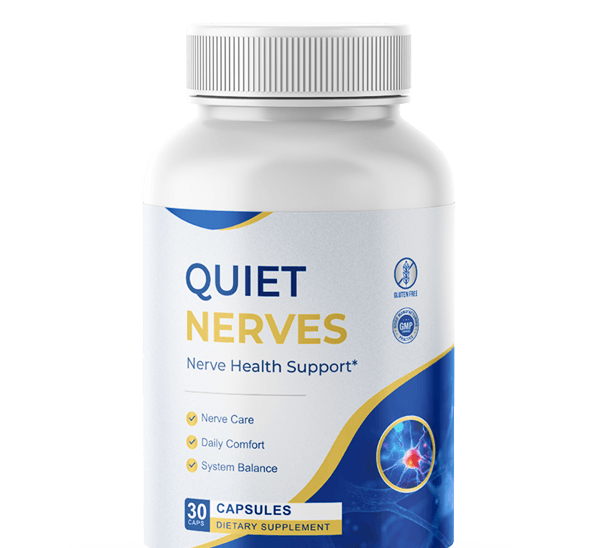
The name on the label was Quiet Nerves. What she read surprised both of us, because it lined up almost exactly with the "end of the line" problem.
- L-Carnitine. "Never heard of it," she said. When I looked it up: it's something your cells use to make energy, and the company's page points out that levels drop with age and that the peripheral nerves, the ones in your hands and feet, are among the first to feel it. Fuel for the far end.
- Butcher's Broom. She laughed at the name. It's an old European plant, and the company names it for supporting healthy circulation, especially in the lower legs. Delivery for the far end.
- Alpha lipoic acid. This one she knew. It has been studied for years in people with nerve trouble in their feet, and it's an antioxidant aimed at the wear and tear around the nerve.
- Magnesium glycinate. "I already take magnesium to sleep," she said. This is the gentle form. Nerves use magnesium both to fire and to settle down.
- Turmeric, 95% curcuminoids, and CoQ10. The turmeric is for the slow background irritation, and it's the standardized extract, not the spice from the jar. The CoQ10 is another piece of the nerve cell's energy machinery, plus circulation.
"So it's not a numbing pill," she said, putting her glasses back on her head. "It's groceries for my feet." That's when she stopped trying to give it back to me.
What pushed her the rest of the way was two small things. It's one capsule a day, which after her drugstore cabinet felt doable. And the company offers a 60-day satisfaction promise from the purchase date, so if nothing changed she could write to them and be done with it.
What happened, month by month
She takes one capsule every morning with breakfast and a full glass of water, the way the company suggests, before the dog walk. She showed her doctor the label first, and he had no objection. Here is her timeline, as honestly as she gave it to me.
- Week 1. Nothing. She told me on day five, "Still fizzy. I'm finishing Jean's bottle so she can't say I didn't try."
- Weeks 2 and 3. The fizz in the evenings wasn't gone, but it wasn't climbing up into the balls of her feet anymore. She noticed because she stopped rubbing her feet on the edge of the couch while she watched the news.
- Month 1. The first thing she noticed wasn't the tingle at all. It was that she walked the dog all the way to the park and back on the bumpy stretch of sidewalk and realized she hadn't been looking at her feet the whole time.
- Months 2 and 3. She took the porch steps one morning holding her coffee, without the railing, and only noticed afterward. She still feels a tingle some nights. She trusts her feet again, and at 67 that is most of the battle.
Why did it take that long? Because nothing in it numbs anything. A nerve ending that has been running on empty for a year doesn't refill in a weekend; it takes weeks of steady feeding for it to steady itself. The company says many people notice something in the first two to four weeks, and Barbara was right in that window, but the part that mattered most to her, the balance, came later. That's why her own order, after Jean's bottle ran out, was the six-month supply instead of a single bottle. She did not want to stop just as it was starting to work.
If you have started watching your feet on the stairs too, this is the bottle Barbara's sister mailed her.
See what Barbara read on the label →Who this is for, and who it isn't
It may be worth a look if you are over 50, your toes or feet tingle, fizz or feel half asleep most days, it has been going on for weeks or months, you have had the basics checked (blood sugar, B12, thyroid), and the soaks, socks and creams only help while you're using them.
It is not for you if the numbness came on suddenly, is spreading quickly, affects one side of your body, comes with weakness in a leg, or there's a sore on your foot that won't heal. That needs a doctor this week, not a supplement. If you are pregnant, nursing, under 18, or on a long list of prescriptions, show your doctor the label first. Barbara did.
The promise that made it easy to say yes
The company's page shows a 60-day satisfaction promise from the original purchase date: if you're not satisfied, you contact them and they make it right. Barbara's worst case was two months of one capsule a day and an email. Her best case was trusting her own porch steps again.
Don't wait for your own "bottom step" morning to find out what the tingle was trying to tell you.
Start your 60-day try of Quiet Nerves →Where she is now
Results vary, and hers are hers. She still checks her feet every night, still sees her doctor, still keeps an eye on her blood sugar. But she walks the terrier at seven again without staring at the sidewalk, and she mowed her own edges last Saturday while I watched from my porch with Tom.
P.S. Barbara asked me to add one thing. She says the worst part of last year wasn't the tingle, it was that she kept asking "when should I be concerned?" and kept answering "not yet." If that's you tonight, with your toes fizzing under the blanket, this is the page she wishes Jean had sent her a year sooner.
I'll send you the next one
— Denise
No spam, no daily noise. Just what I actually did, written the way I actually lived it, sent when I write it.
Thanks — you're on the list.
This is a first-person account shared with Health Choice Review and is not medical advice, a diagnosis, or a recommendation of any treatment or product. Nerve symptoms and their causes vary between individuals. Always consult a licensed physician about your own health, and never start, stop or change a treatment based on anything you read here.